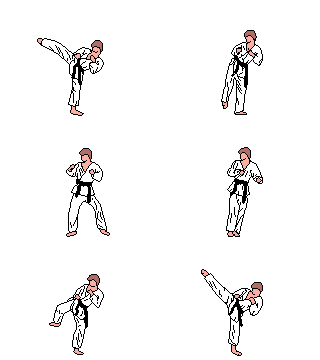
2nd Gup Syllabus
Stances
Vertical stance (soojik sogi)
Close ready stance C (moa junbi sogi C)
Sliding (mikulgi)
Defensive techniques
Palm pushing block (sonbadak miro magki)
Side front block (yobap magki)
Front checking kick (apcha momchugi)
Side checking Kick (yopcha momchugi)
Flying hooking Kick (twimyo golcho chagi)
Offensive techniques
Upward punch (ollyo jirugi)
Knifehand downward strike (sonkal naeryo taerigi)
Side elbow thrust (yop palkup tulgi)
Four directional thrust (saju tulgi)
Mid - air kick (twio dolmyo chagi)
Flying kicks (twimyo chagi)
PATTERNS
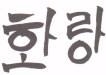
Hwa-Rang Tul
29 movements
 |
Hwa-Rang is named after the Hwa-Rang youth group which originated in the Silla Dynasty in the early 7th century.
The 29 movements refer to the 29th Infantry Division, where Taekwon-Do developed into maturuity.
|
 |
The Hwa-Rang code of conduct
Be loyal to your King - Be obedient to your parents - Be honourable to your friends - Never retreat in battle - Make a just kill
.
Ready Posture: Close ready stance C
1. Move the left foot to B to form a sitting stance toward D while executing a middle pushing block to D with the left palm.
2. Execute a middle punch to D with the right fist while maintaining a sitting stance toward D.
3. Execute a middle punch to D with the left fist while maintaining a sitting stance toward D.
4. Execute a twin forearm block while forming a left L-stance toward A, pivoting the left foot.
5. Execute an upward punch with the left fist while pulling the right side fist in front of the left shoulder, maintaining a left L-stance toward A.
6. Execute a middle punch to A with the right fist while forming a right fixed stance toward A in a sliding motion.
7. Execute a downward strike with the right knifehand while forming a right vertical stance toward A, pulling the right foot.
8. Move the left to A, forming a lrft walking stance toward A while executing a middle punch to A with the left fist.
9. Move the left foot to D, forming a left walking stance dtoward D while executing a low block to D with the left forearm.
10. Move the right foot to D, forming a right walking stance toward D while executing a middle punch to D with the right fist.
11. Pull the left foot toward the right foot while bringing the left palm to the right forefist at the same time bending the right elbow about 45 degrees outward.
12. execute a middle side piercing kick to D with the right foot while pulling both hands in the opposite direction, and then lower it to D, forming a left L-stance toward D, at the same time executing a middle outward strike to D with the right knifehand.
13. Move the left foot to D, forming a left walking stance toward D while executing a middle punch to D with the left fist.
14. Move the right foot to D, forming a right walking stance toward D, at the same time executing a middle punch to D with the right fist.
15. Move the left foot to E, turning counter-clockwise to form a right L-stance toward E while executing a middle guarding block to E with a knifehand.
16. Move the right foot to E, forming a right walking stance toward E while executing a middle thrust to E with the right straight fingertip.
17. Move the right foot on line EF, forming a right L-stance toward F while executing a middle guarding block to F with a knifehand.
18. Execute a high turning kick to DF with the right foot and then lower it to F.
19. Execute a high turning kick to CFwith the left foot and then lower it to F, forming a right L-stance toward F while executing a middle guarding block to F with a knifehand.
Perform 18 & 19 in a fast motion.
20. Move the left foot to C, forming a left walking stance toward C while execuiting a low block to C with the left forearm.
21. Execute a middle punch to C with the right fist while forming a right L-stance toward C, pulling the left foot
22. Move the right foot to C, forming a left L-stance toward C while executing a middle punch to C with the left fist.
23. Move the left foot to C, forming a right L-stance toward C, at the same time executing a middle punch to C with the right fist.
24. Execute a pressing block with an X-fist while forming a left walking stance toward C, slipping the left foot to C.
25. Move the right foot to C in a sliding motion, forming a right L-stance toward D while thrusting to C with the right side elbow.
26. Bring the left foot to the right foot, turning counter-clockwise to form a close stance toward B while executing a side front block with the right inner forearm while extending the left forearm to the side downward.
27. Execute a front side block with the left inner forearm, extending the right forearm to the side downward while maintaining a close stance toward B.
28. Move the left foot to B, forming a right L-stance toward B, at the same time executing a middle guarding block to B with a knifehand.
29. Bring the left foot to the right foot and then move the right foot to A, forming a left L-stance toward A while executing a middle guarding block to A with a knifehand.
End: Bring the right foot back toready posture.
|
SPARRING
Two step sparring (ilbo matsogi)
Compulsory techniques: Flying reverse hooking kick, flying downward kick, mid-air kick
The attacker performs the following attacks:
From a right L-stance guarding block, move forward and perform:
1. right walking stance front punch / left low front snap kick.
2. Right middle front snap kick / right walking stance high front punch
3. Left L-stance side punch / left middle side turning kick
4. Right high side turning kick / step down then step forward to right L-stance side punch
5. Left L-stance knifehand side strike / left middle side piercing kick
6. Right middle back piercing kick / right X-stance back side fist
Free sparring (jayu matsogi) grading & tournament (Should contain flying kicks)
Self Defence
Release per Hwa-Rang, movement 11
Defence against double hook
Defence against grab & hook
Knife attack - outward slash
Baton attack - outward slash
Rolling breakfalls - forward & backward
DESTRUCTION
Knifehand side strike (sonkal yop taerigi) Reverse knifehand strike (sonkal dung taerigi)
Front elbow strike (ap palkup taerigi) Juniors (front elbow strike only)
THEORY
All Taekwon-Do terminology above
Procedure for leading the class
Face the flag - kukki e tae hae
Face Instructor - (1st to 3rd Dan) - boosabum nim kke
Face Instructor - (4th to 6th Dan) - sabum nim kke
Face Master - (7th & 8th dan) - sahyun nim kke
Face Grand Master - (9th dan) - saseong nim kke
Ready - junbi Start - si jak Stop - guman At ease - swiyo Repeat - tashi
Return - baro Yell - kihap About turn - twio tora Class dismissed - hae san
Meaning of the red belt
Red signifies danger, cautioning the student to exercise control and warning the opponent to stay away.
History of Taekwon-Do
Taekwon-Do was named on 11th April 1955. This is not to say that Korean martial arts did not exist before then, but that was the year in which the name was first put forward.
The origins of Taekwon-Do can be traced to Tae Kyon, the art of self defence which originated 1300 years ago during the Silla Dynasty in Korea. Tae Kyon was taught and practised among the youths of 'Hwarang-Do', who were hand picked to be trained as military leaders of Silla, one of the three ruling kingdoms of Korea at that time. Tae Kyon's effectiveness was enhanced at the turn of the 20 century, when hand techniques were introduced from China and later from Japan.
Japan occupied Korea for many years and during the Second World War the two countries were co-belligerants. Many Koreans fought on the side of the Japanese and recieved training in the Japanese martial arts systems.
One of the most prominent personalities at this time was General Choi Hong Hi.
Gen. Choi had studied the Korean art of tae Kyon as a child and as a student in Japan he had learned Karate. This combination of Korean and Japanese knowledge was to form the basis of his teachings at the academy of martial arts formed in 1953. Being a professional soldier, he was able to introduce the teaching of his system to the men under his command. Through his military liasion with foreign units, Gen. Choi spread the knowledge of his system until it became international. Gen. Choi organised the first international demonstration tour, the consequences of which contributed towards the eventual formation of the International Taekwon-Do Federation on 22 March 1966. In 1972, as a result of political pressure within South Korea, Gen. Choi left the country to re-establish the headquarters of the ITF in Canada, later to be relocated to Vienna. The Korean government quickly set up a rival international body, calling it the World Taekwon-Do Federation. Since that time, Taekwon-Do has been divided, and the techniques, patterns and systems differ between the two styles. ITFNZ continue to practice the original form of Taekwon-Do, The Chang-Hon style.
The theories, terminology, techniques, systems, methods, rules, uniform, and philosophical foundation were scientifically developed, systemizesd and named by Gen. Choi Hong Hi. Hence it is an error to think of any other actions employing the feet or hands for self defence as Taekwon-Do. On a philosophical level, Taekwon-Do is derived from the traditional, ethical and moral principals of the Orient and from the personal philosophy of Gen. Choi.
The Physical techniques of Taekwon-Do are based on the principals of modern science, in particular Newtonian physics which teaches us how to generate maximum power. Although Karate and Tae Kyon were used as references in the coarse of developing the art, the fundamental theories and principles of Taekwon-Do are different from those of any other martial art.
Credits: Minimum of 7 since starting TKD