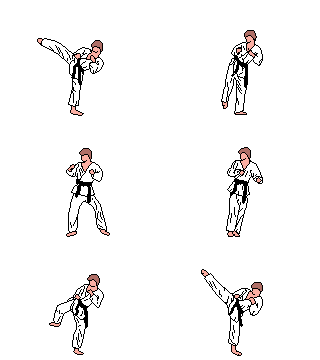
3rd Gup Syllabus
Defensive Techniques
X- fist pressing block
kyocha joomuk noollo magki
The X-fist pressing block can be performed from nearly every stance, though walking, sitting, and X-stances are most commonly used. the X-fist is used against the tibia of the attacking foot aimed at the defender's lower abdomen.
|
|
W-shape block
san magki
This technique has dual functions: one is used against either a foot or hand attack to the philtrum and areas above, and the other is to strengthen the leg muscles. The outer forearm and knifehand are the principal tools, though occasionally a reverse knifehand or inner forearm is used. Although the sitting and walking stances are mostly used, parallel, close, one-leg and X-stances are also employed. The sitting, parallel, close and one-leg stances are used against the attack either from front or side, whereas the walking and X-stances are only for the side. Dip the elbows slightly below the shoulder at the moment of the block.
|
|
Double forearm low pushing block
doo palmok najunde miro makgi
A low double forearm pushing block is executed from rear foot and L-stances only
|
|
Backfist side back strike
dung joomuk yopdwi taerigi
This technique is useful for attacking an opponent standing at the side rear angle. It can be executed from nearly every stance, though walking, sitting and close stances are mostly employed. The backhand can also be used in rare cases. Keep the attacking tool full facing the target while extending the opposite arm to the side-downward at the moment of impact.
|
|
Knifehand low guarding block
sonkal najunde daebi makgi
When executing this technique the following points should be observed.
1. The knifehands generally form a parallel line.
2. The distance between the opposite knifehand and lower abdomen is about 3 centimetres.
3. The forearm becomes parallel to the thigh.
4. The elbow of the blocking arm is bent about 15 degrees outward.
|
|
Flying crescent kick
twimyo bandal chagi
The purpose of this technique is to block the opponent's attacking hand or foot while flying.
The method of kicking is the same as that of the cresent kick except the flying motion.
Offensive Technique
Upset fingertip thrust
dwijibun sonkut tulgi
This technique is mainly executed from a walking, L-orX-stance, though occasionally from a rear foot stance. It is used chiefly against the pubic region but occasionally the armpit. Insure that the opposite side fist is brought in front of the shoulder at the moment of impact. A reverse thrust is normal in the case of a walking stance.
|
|
Twin side elbow thrust
sang yop palkup tulgi
The philtrum and solar plexus are the main targets with the floating ribs and chest as secondary. Keep both side fists faced downward at the moment of impact.
|
|
Upward kick
ollyo chagi
This technique is used in attacking the solar plexuis or chest at close range Be sure to pull down the opponent's head or shoulder with both hands while kicking.
|
|
Flying kicks: as listed below in one step sparring
twimyo chagi
PATTERNS
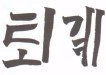
Toi-Gye Tul
37 movements
 |
Toi-Gye is the pen name of the noted scholar Yi Hwang
(16th century), an authority on neo-Confucianism.
The 37 movements of the pattern refer to his birthplace
on 37 degrees latitude, and the diagram represents scholar.
|
 |
Ready Posture: parallel ready stance
1. Move the left foot to B, forming a right L-stance toward B while executing a middle block to B with the left inner forearm.
2. Execute a low thrust to B with the right upset fingertip while forming a left walking stance toward B, slipping the left foot to B.
3. Bring the left foot to the right foot to form a close stance toward D while executing a side back strike to C with the right back fist, extending the left arm to the side-downward.
Perform in a slow motion.
4. Move the right foot to A, forming a left L-stance toward A while executing a middle block to A with the right inner forearm.
5. Execute a low thrust to A with the left upset fingertip while forming a right walking stance toward A, slipping the right foot to A.
6.Bring the right foot to the left foot to form a close stance toward D while executing a side back strike to C with the left back fist, extending the right arm to the side-downward.
Perform in a slow motion.
7. Move the left foot to D, forming a left walking stance toward D while executing a pressing block with
an X-fist.
8. Execute a high vertical punch to D with a twin fist while maintaining a left walking stance toward D.
9. Execute a middle front snap kick to D with the right foot, keeping the position of the hands as they
were in 8.
10. Lower the right foot to D, forming a right walking stance toward D while executing a middle punch to D with the right fist.
11. Execute a middle punch to D with the left fist while maintaining a right walking stance toward D.
12. Bring the left foot to the right foot, forming a close stance toward F while executing a twin side
elbow thrust.
Perform in a slow motion.
13. Move the right foot to F in a stamping motion, forming a sitting stance toward C while executing a
W-shape block to C with the right outer forearm.
14.Move the left foot to F in a stamping motion, turning clockwise to form a sitting stance toward D while executing a W-shape block to D with the outer forearm.
15. Move the left foot to E in a stamping motion , turning clockwise to from a sitting stance toward C, at the same time executing a W-shape block to C with the left outer forearm.
16. Move the right foot to E in a stamping motion, turning counter- clockwise to form a sitting stance toward D while executing a W-shape block to D with the right outer forearm.
17. Move the left foot to E in a stamping motion, turning clockwise to form a sitting stance toward C, at the same time executing a W-shape block to C with the left outer forearm.
18. Move the left foot to F in a stamping motion, turning clockwise to form a siiting stance toward D while executing a W-shape block to D with the left outer forearm.
19. Bring the right foot to the left foot and then move the left foot to D, forming a right L-stance toward D while executing a low pushing block to d with the left double forearm.
20. Extend both hands upward as if to grab the opponent's head while forming a left walking stance toward D, slipping the left foot to D.
21. Execute an upward kick with the right knee while pulling both hands downward.
22. Lower the right foot to the left foot and then move the left foot to C, forming a right L-stance toward C while executing a middle guarding block to C with a knifehand.
23. Execute a low side front snap kick to C with the left foot, keeping the position of the hands as
they were in 22.
24. Lower the left foot to C, forming a left walking stance toward C while executing a high thrust to C with the left flat fingertip.
25.Move the right foot to C, forming a left L-stance toward C while executing a middle guarding block to C with a knifehand.
26. Execute a low side front snap kick to C with the right foot, keeping the position of the hands as
they were in 25.
27. Lower the right foot to C, forming a right walking stance toward C, at the same time executing a high thrust to C with the right flat fingertip.
28.Move the right foot to D, forming a right L-stance toward C while executing a side back strike to D with the right back fist and a low block to C with the left forearm.
29. Jump to C, forming a right X-stance toward A while executing a pressing block with an X-fist.
30. Move the right foot to C, forming a right walking stance toward C while executing a high block to C with the right double forearm.
31.Move the left foot to B, forming a right L-stance toward B while executing a low guarding block to B with a knifehand.
32. Execute a circular block to BD with the right inner forearm while forming a left walking stance toward B, slipping the left foot to B.
33. Bring the left foot to the right foot and then move the right foot to A, forming a left L-stance toward A, at the same time executing a low guarding block to A with a knifehand.
34. Execute a circular block to AD with the left inner forearm while forming a right walking stance toward A, slipping the right foot to A.
35. Execute a circular block to CE with the right inner forearm while forming a left walking stance toward A,
slipping the front foot toward CE.
36. Execeute a circular block to CE with the left inner forearm while forming a right walking stance
toward A.
37. Move the right foot on line AB to form a sitting stance toward D while executing a middle punch to D with the right fist.
End: Bring the right foot back to ready posture.
|
SPARRING
One step sparring (ilbo matsogi) - flying techniques
Compulsory techniques:
Flying crescent kick, flying twisting kick, flying reverse turning kick, flying vertical kick
1. Attack - punch / counter attack - flying crescent kick, side piercing kick
2. Attack - punch / counter attack - flying twisting kick
3. Attack - punch / counter attack - flying vertical kick
4. Attack - punch / counter attack - flying reverse turning kick
5 to 10. Attack - own choice / counter attack - own choice
Free sparring (jayu matsogi) grading & tournament (Should contain flying kicks)
SELF DEFENSE
Defence against backfist strike
Defence against hook
Knife attack inward slash
Baton attack inward slash
Breakfalls - side, front, and back
Destruction
Flying front kick (twimyo apcha busigi) Flying turning kick (twimyo dollyo chagi)
Flying side piercing kick (twimyo yopcha jirugi) Flying back piercing kick (twimyo dwitcha jirugi)
Theory
All Taekwon-Do terminology above
Foot parts
Ball of the foot - apkumchi
Knee - moorup
Reverse footsword - balkal dung
Footsword - balkal
Back heel - dwitchook
Explanation of the tenets
Courtesy - Ye Ui
Taekwon-Do students should attempt to practise the following elements of courstesy to build up their noble character and to conduct their training in an orderely manner as well.
1) To be polite to one another
2) To encourage a sense of justice and humanity
3) To distinguish instructor from student, senior from junior, and elder from younger
4) To behave oneself according to ettiquette
5) To respect other's possessions
Integrity - Yom Chi
In Taekwon-Do, the word integrity assumes a looser definition than the one usually presented in a dictionary. One must be able to define right from wrong and have the conscience, if wrong, to feel guilt. Listed are some examples where integrity is lacking.
1) The student who requests rank from an instructor , or attempts to purchase it.
2) The student who gains rank for ego purposes or the feeling of power.
Perserverance - In Nae
There is an old Oriental saying, "Patience leads to virtue or merit" - "One can make a peaceful home by being patient for 100 times". Certainly, happiness and prosperity are most likely to come to the patient person. To achieve something, whether it is a higher degree or the perfection of a technique, one must set a goal then constantly persevere. One of the most important secrets in becoming a leader of taekwon-Do is to overcome every difficulty by perserverance.
Self Control - Guk Gi
This tenet is extremely important inside and outside the do jang, whether conducting oneself in free sparring or in one's personal affairs. An inability to live and work within one's capability or sphere is also a lack of self control. According to Loa-Tzu "the term of stronger is the person who wins over oneself rather than someone else".
Indominable Spirit - Baekjul Boolgool
Indominaable spirit is shown when a courageous person and their principles are pitted against overwhelming odds. A serious student of Taekwon-Do will at all times be modest and honest. If confronted with injustices, he/she will deal with the belligerent without any fear or hesitation at all, with indominable spirit, regardless of whosoever and however many the number.
Credits: Minimum of 6 since starting Taekwon-Do