4th Gup Syllabus
STANCES
Low stance
(nachuo sogi)
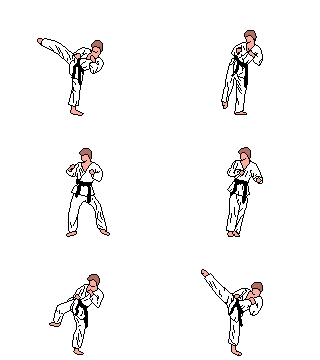
This stance is similar to walking stance,though it is longer by one foot. It can be either full facing or half facing.
The advantage of this stsnce is the ease with which one can extend the attacking tool. it can also develop the leg
muscles and is effective to adjust the distance to and from the target.
|
Rear foot stance
(dwitbal sogi)
This is used for defense and occasionally for attack. The advantage of this stance is the ability to kick or adjust the distance from an opponent with the front foot which can move spontaneously without any additional shifting of the body weight to the rear foot.
1. Move one foot to either the front or the rear at a distance of one shoulder width between the small toes.
2. bend the rear leg until the knee comes over the toes, placing the heel slightly beyond the heel of the front foot.
3. Bend the front leg, touching the ground slightly with the ball of the foot.
4. keep the toes of the front foot pointing about 25 degrees and the toes of the rear foot about 15 degrees inward.
5. Distribute most of the body weight on the rear foot.
When the right foot is in the rear, the stance is called a right rear foot stance and vice-versa. It is always half facing, both in attack and defense.
Be sure to keep the knee of the rear leg pointing slightly inward.
|
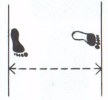 One Shoulder width
|
Close ready stance B
moa junbi sogi B
The distance between the fists and the navel is
about 15 centimetres
|
|
|
Foot shifting
(jajun bal)
This maneuver is employed chiefly for adjusting the shortest distance from the opponent and can be performed by moving a single foot or both feet. When shifting, the motion should be smooth. Avoid dragging the foot across the ground or lifting it more than necessary.
Single foot
The advantage of this technique is that it permits the student to perform any attack or defense while in the act of dodging. Single foot shifting can be done from virtually any stance, bit the rear foot and L-stances are most ideally suited for this maneuver because they allow the student to use the same foot to counter-attack immediatley after or while still in the process of dodging.
DEFENSIVE TECHNIQUES
Reverse knifehand side block
sonkal dung yop makgi
This technique can be performed in most stances with the body half-facing, and the reverse knifehand being the blocking tool.
|
|
Palm upward block
sonbadak ollyo makgi
This is performed mostly with a rear foot or L-stance though occasionally a walking stance is used. The blocking tool should reach the target in a circular motion.
The purpose of this block is to "spring up" an opponents hand, foot, dagger or stick directed against the defenders solar plexus and area above. The palm should reach its point of focus at the defenders solar plexus. Be sure to bend the elbow about 35 degrees outward at the moment of the block.
|
X-fist rising block
kyocha joomuk chookyo makgi
This technique is particulary powerful when used against a downward strike with a pole or hand technique. The wrists must be crossed in the center of the forehead at the moment of the block. Although occasionally a close or one-leg stance is used, walking, sitting, parallel and X-stances are mostly employed.
|
|
Palm pressing block
sonbadak noollo makgi
A pressing block is executed against a low attack only. This technique is used only when the defender wishes to check, rather than break the attacking foot. The palm, twin palm, forefist, and X-fist can all be used as blocking tools.
When blocking with the palm, this block is always accomanied by a palm upward block and executed from a walking or low stance. Not only is it good for muscle and breath control exercise, but it can block two targets simultaneously. keep both elbows bent slightly outward while blocking. The instep is the only target for pressing.
|
|
U-shape block
digutja makgi
The sole purpose of this technique is to block either a pole or bayonet with a reverse knifehand. This is performed mainly with fixed and L-stances, though occasionally walking, rear foot or X-stances are used. Keep both hands in a vertical line at the moment of the block. The lower elbow should be flush with the hip while leaning the body slightly towards the target at the moment of the block.
|
|
Offensive techniques
Upper elbow strike
wi palkup taerigi
This is usually executed from a walking stance. A reverse strike is common in the case of a walking stance and it is employed for attacking the opponent at a side front angle. The only target is the point of the chin. At the moment of impact the body becomes full facing with the back fist facing upward.
|
|
Twin vertical punch
sang joomuk sewo jirugi
This technique is mainly performed with walking, close, parallel and X-stances, and ocassioanoly with a sitting, one leg or L-stance. The high vertical punch with a twin fist is normally executed against one target, and two targets in rare instances, whereas two targets are dealt with in the case of a middle punch.
|
|
Twin fist upset punch
sang joomuk dwijibo jirugi
This technique is very useful for attacking two targets simultaneously.
It is performed mainly with walking, close , parallel and X-stances but occasionally sitting or one-leg stance is used.
|
|
Angle punch
giokja jirugi
Both the purpose and method of this technique are very similar to those of a turning punch except that the fist reaches the opposite chest at the moment of impact. An oberse punch is normal in the ase of a walking stance.
|
|
Flying kicks: as listed below in one step sparring
twimyo chagi
Flying kicks have a nuber of advantages: they perfect balance, develop coordination, condition muscles and are invaluable for attacking the high section of the body with the foot as well as developing timing and focus. they are also effective for vaulting obstacles without exposing oneself to an attack, for leaping over a pole, club or knife attack, and for stopping an onrushing or fleeing opponent, closing distances, and driving through an encirclement of several opponents.
A flying kick is performrd with either one motion from the spot or several motions while running: the former is most practical at a closest distance, the latter at further distances.
The following priciples must be observed with all flying kicks.
1. The kick must be executed when the body reaches the apex of the jump.
2. With few exceptions, the back must be straight at the moment of impact.
3. The non-kicking foot must be tucked and not drooped at the moment of impact.
4. Immediately after kicking, resume a good posture and balance.
5. Proper stance must be regained at the moment of landing.
Patterns
Joong-Gun Tul
32 movements
 |
Joong-Gun is named after the patriot Ahn Joong-Gun who assassinated Hiro Bumi Ito, the first Japanese
governor-general of Korea, known as the man who played thew leading part in the Korea-Japan merger. There are 32 movements in this pattern to represent Mr Ahn's age when he was executed at Lui-Shung prison in 1910.
|
 |
Ready posture: Close ready stance B.
1. Move the left foot to B, forming a right L-stance toward B while executing a middle block to to B with the left reverse knifehand.
2. Execute a low side front snap kick to B with the left foot, keeping the position of the hands as they were
in 1.
3. Lower the left foot to B and then move the right foot to B, forming a left rear foot stance toward B while executing an upward block with a right palm.
4. Move the right foot to A, forming a left L-stance toward A, at the same time executing a middle block to A with a right reverse knifehand.
5. Execute a low side front snap kick to A with the right foot, keeping the position of the hands as they were in 4.
6. Lower the right foot to A, and then move the left foot to A, forming a right rear foot stance toward A while executing an upward block with the left palm.
7. Move the left foot to D, forming a right L-stance toward D while executing a middle guarding block to D with a knifehand.
8. Execute a right upper elbow strike while forming a left walking stance toward D, slipping the left foot to D.
9. Move the right foot to D, forming a left L-stance toward D, at the same time executing a middle guarding block to D with a knifehand.
10. Execute a left upper elbow strike, at the same time forming a right walking stance toward D, slipping the right foot to D.
11. Move the left foot to D, forming a left walking stance toward D while executing a high vertical punch to D with a twin fist.
12. Move the right foot to D, forming a right walking stance toward D while executing an upset punch to D with a twin fist.
13. Move the right foot on line CD, and then turn counter-clockwise to form a left walking stance toward C while executing a rising block with an X-fist.
14. Move the left foot to E, forming a right L-stance toward E while executing a high side strike to E with the left back fist.
15. Twist the left fist counter-clockwise until the back fist faces downward, at the same time forming a left walking stance toward E, slipping the left foot to E.
16. Execute a high punch to E with the right fist while maintaining a left walking stance toward E.
Perform 15 & 16 in a fast motion.
17. bring the left foot to the right foot and then move the right foot to F, forming a left L-stance toward F while executing a high side strike to F with a right back fist.
18. Twist the right fist clockwise until the back fist faces downward while forming a right walking stance toward F, slipping the right foot to F.
19. Execute a high punch to F with the left fist while maintaining a right walking stance toward F.
Perform 18 & 19 in a fast motion.
20. Bring the right foot to the left foot and then move the left foot to C, forming a left walking stance toward C while executing a high block to C with the left double forearm.
21. Execute a middle punch to C with the left fist while forming a right L-stance toward C, pulling the left foot.
22. Execute a middle side piercing kick to C with the right foot.
23. Lower the right foot to C, forming a right walking stance toward C while executing a high block to C with the right double forearm.
24. Execute a middle punch to C with the right fist while forming a left L-stance toward C, pulling the right foot
25. Execute a middle side piercing kick to C with the left foot.
26. Lower the left foot to C, forming a right L-stance toward C while executing a middle guarding block to C with the forearm.
27. Execute a pressing block with the right palm while forming a left low stance toward C, slipping the left foot to C. Perform in slow motion.
28. Move the right foot to C, forming a left L-stance toward C while executing a middle guarding block to C with the forearm.
29. Execute a pressing block with the left palm while forming a right low stance toward C, slipping the right foot to C. Perform in slow motion.
30. Bring the left foot to the right foot, forming a close stance toward A while executing an angle punch with the right fist. Perform in slow motion.
31. Move the right foot to A, forming a right fixed stance toward A while executing a U-shape block to A.
32. Bring the right foot to the left foot and then move the left foot to B, forming a left fixed stance toward B, at the same time executing a U-shape block to B.
End: Bring the left foot back to ready posture.
|
Sparring
One step sparring (ilbo matsogi) flying techniques
Compulsory techniques:
Flying front snap kick, flying turning kick, flying side piercing kick, flying back piercing kick.
1. Attack - punch / counter attack - flying front snap kick
2. Attack - punch / counter attack - flying turning kick
3. Attack - punch / counter attack - flying side piercing kick
4. Attack - punch / counter attack - flying back piercing kick
5 to 10. Attack - own choice / counter attack own choice
Free sparring (jayu matsogi) grading & tournament (Should contain flying kicks)
Self Defence
showing: attacking, breaking and releasing
Release per Joong-Gun, movements 15 & 18
Defence against twin palm push
Defence against straight punch
Knife attack - front thrust
Baton attack - front thrust
Destruction
Front snap kick (apcha busigi), turning kick (dollyo chagi),
Side piercing kick (yopcha jirugi), back piercing kick (dwitcha jirugi)
Theory
All Taekwon-Do Terminology above
Meaning of the blue belt
Blue signifies the Heaven, towards which the plant matures into a towering tree as training in taekwon-Do progresses.
Taekwon-Do in New Zealand
Taekwon-Do is well established in New Zealand, with our organisation having clubs nationwide. The first of these was established by Mr Norman Ng in Palmerston North, 1970. On 28th March 1981 the name International Taekwon-Do Foundation was chosen and registered as an incorperated society. Since then we have grown into a well organised network of branches, who come together regularly for seminars, camps and tournaments.
The foundation operates under a duly elected executive committee which has sub-committees in charge of techniques, standards and discipline, promotions, tournaments, and gradings. All our branches are run by officially certified instructors who must keep their instructors and first aid certificates current. All gradings are conducted by appointed examiners of at least 4th dan, so our standards are maintained at the highest level.
We have been active in many international events such as the Sharp International Tournament in Wellington, which received national television coverage and attracted participants from all over the world, including Japan and the United States. It was our organisation that performed in the Opening Ceremonies of the 1990 Commonwealth Games, and we are recognised by the New Zealand Hillary Commission. Our sister organisation is the United States Taekwon-Do Federation and we are affiliated to the International Taekwon-Do Federation.
Credits: Minimum of 5 since starting TKD