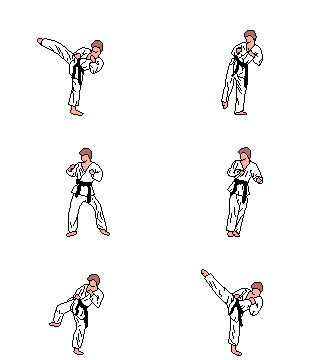
5th Gup Syllabus
X-stance / Jumping X-stance / Twin knifehand block / Double forearm block / Palm hooking block / Hooking kick
Front elbow strike Back snap kick / Side pushing kick / Skip kick / Yul-Gok / Sparring / Self defence / Destruction / Theory
STANCES
 Front view of a
right X-Stance
|
X-stance (kyocha sogi) Jumping X-stance (twigi kyocha sogi) This is a very convenient stance, in particular for attacking the side or front in a jumping motion. it is frequently used for blocking and serves as a preparatory stance for moving into the next manoeuvre.
1. Cross one foot over or behind the other, touching the ground slightly with the ball of the foot.
2. Place the body weight on the stationary foot.
3. One foot always crosses over the front of the other with the exception of a jumping motion.
When the weight is rested on the right foot, the stance is called a right X-stance and vice versa. The other foot is usually placed in front of the stationary foot. It can be full, side or half facing both in attack and defense.
|
|
DEFENSIVE TECHNIQUES
| Twin knifehand block (sang sonkal makgi)
Both the method and purpose are the same as those of a twin forearm block; with knifehand being the blocking tool.
|
|
| Double forearm block (doo palmok magki)
This is one of the strongest forms of blocking. The advantage of this technique is the ability to to quickly shift one forearm into another block while still blocking with the other.
It is mainly performed in a walking or X-stance, though occasionally an L-stance or rear foot stance also. Only the inner forearm is used. Always be sure to keep the body half facing the target, bringing the second knuckle of the little finger to the elbow at the moment of the block.
|
|
| Palm hooking block (sonbadak golcho makgi)
Unlike other methods of blocking, this technique requires a minimun amount of effort on the part of the defender, and allows the opposite hand or foot an immediate response for counter- attacking. Although a hooking block can be performed with an outer forearm, knifehand or back hand, the palm is most effective.
This technique can be used in nearly all stances, though walking stance is commonly used. An inside block can be used but an outside block can best insure blocking of the opponents free hand. The blocking tool must reach the target in an arc so it is able to be properly placed on the opponent's back forearm or outer tibia.
Palm: Keep the elbow bent about 25 degrees outward and the wrist slightly inward at the moment of the block. The palm is the best tool for increasing the chances of making a successful grab.
|
|
| Hooking kick (golcho chagi)
The same method of a hooking block with a back hand is applicable to this techniqe. The target areas are the elbow joint and achilles tendon. The blocking tool is the side instep which reaches the target in an outward curve unlike a twisting kick.
It is advisable to execute the kick at the outside of the attacking hand or foot. The kicking foot can also be used as an instantaneous counter-attack motion. keep the outer tibia facing downward at the moment of impact. This technique is divided into low and middle hooking kicks.
|
|
OFFENSIVE TECHNIQUES
| Front elbow strike (ap palkup taerigi)
It is mainly executed from a walking, close, X or parallel stance. The striking force is strengthened with the aid of the opposite palm during practice and is used mainly to attack the philtrum, jaw, ribs or solar plexus from the side front angle. The body becomes full facing with the back fist facing upward at the moment of impact. A reverse strike is common in the case of a walking stance. be sure to bring the opposite palm either to the elbow or side fist at the moment of impact.
|
|
| Back snap kick (dwitcha busigi)
The back snap kick is used to attack an opponent who is approaching from the rear, without changing the direction of the stance. This technique is especially useful in attacking the opponent who is holding with a rear grab.
The back heel is the attacking tool while the scrotum is the target. Be sure to lean the body slightly forward while kicking.
The back heel reaches the target in a straight line and maximum knee spring must be used with the stationary leg.
|
|
| Side pushing kick (yopcha milgi)
This is a variation of a side piercing kick. Thi technique, however, utilizes only weight or mass without acceleration and power, therefore losing the the peircing force and naturally rapid withrawal of the kicking foot becomes less important. The footsword is the only attacking tool used with this technique.
Unlike other kicks, this particular one can be executed only from sitting, diagonal and parallel stances. Be sure to cross the other foot rapidly past where the kicking foot had been placed while kicking and push the target momentarily.
|
|
Skip kick (duro gamyo chagi)
This technique is useful for attacking an opponent at a distance. Accordingly, the kick is delivered while closing in or pursuing the opponent with a skiping motion. The attacking tools are the ball of the foot, the footsword and the back heel. The skip kick is chiefly performed from a rear foot stance although occasionally an L-stance is used.
The primary attack techniques are turning and side piercing kicks. Reverse turning, hooking and twisting kicks are employed as secondary attacks. Be sure to avoid skipping more than half a shoulders width at a time
Patterns
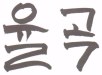
| Yul-Gok Tul 38 movements
 |
Yul-Gok is the psuedonyn of a great philosopher and scholar Yi I (1536 - 1584) nicknamed the 'confucius of Korea'. The 38 movements of this pattern refer to his birthplace on 38 degrees latitude and the diagram represents ' scholar'.
|
 |
Ready posture: Parallel ready stance.
1. Move the left foot to B, forming a sitting stance toward D while extending the left fist to D horizontally.
2. Execute a middle punch to D with the right fist while maintaining a sitting stance toward D.
3. Execute a middle punch to D with the left fist while maintaining a sitting stance toward D. Perform 2&3 in fast motion
4. bring the left foot to the right foot, and then move the right foot to A, forming a sitting stance toward D while extending the right fist to D horozontally.
5. Execute a middle punch to D with the left fist while maintaining a sitting stance toward D.
6. Execute a middle punch to D with the right fist while maintaining a sitting stance toward D.
Perform 5&6 in fast motion.
7. Move the right foot to AD, forming a right walking stance toward AD while executing a middle side block to AD with the right inner forearm.
8. Execute a low front snap kick to AD with the left foot, keeping the position of the hands as they were
in 7.
9. Lower the left foot to AD, forming a left walking stance toward AD while executing a middle punch to AD with the left fist .
10. Execute a middle punch to AD with the right fist while maintaining a left walking stance toward AD.
Perform 9&10 in fast motion.
11. Move the left fot to BD, forming a left walking stance toward BD, at the same time executing a middle side block to BD with the left inner forearm.
12. Execute a low front snap kick to BD, with the right foot, keeping the position of the hands as they were in 11.
13. Lower the right foot to BD, forming a right walking stance toward BD, while executing a middle punch to BD with the right fist.
14. Execute a middle punch to BD with the left fist while maintaining a right walking stance toward BD.
Perform 13&14 in fast motion.
15 Execute a middle hooking block to D with the right palm while forming a right walking stance toward D, pivoting with the left foot.
16. Execute a middle hooking block to D with the left palm while maintaining a right walking stance toward D.
17. Execute a middle punch to D with the right fist while maintaining a right walking stance toward D.
Perform 16&17 in a connecting motion.
18. Move the left foot to D, forming a left walking stance toward D while executing a middle hooking block to D with the left palm.
19. Execute a middle hooking block to D with the right palm while maintaining a left walking stance toward D.
20. Execute a middle punch to D with the left fist while maintaining a left walking stance toward D.
Perform 19&20 in a connecting motion.
21. Move the right foot to D, forming a right walking stance toward D, at the same time executing a middle punch to D with the right fist.
22. Turn the face to D, forming a right bending ready stance A toward D.
23. Execute a middle side piercing kick to D with the left foot.
24. Lower the left foot to D, forming a left walking stance toward D while striking the left palm with the right front elbow.
25. Turn the face toward C while forming a left bending ready stance A toward C.
26. Execute a middle side peircing kick to C with the right foot.
27. Lower the right foot to C, forming a right walking stance toward C while striking the right palm with the left front elbow.
28. Move the left foot to E, forming a right L-stance toward E while executing a twin knifehand block.
29. Move the right foot to E, forming a right walking stance toward E while executing a middle thrust to E with the right straight fingertip.
30. Move the right foot to F, turning clockwise to form a left L-stance toward F while executing a twin knifehand block.
31. Move the left foot to F, forming a left walking stance toward F while executing a middle thrust to F with the left straight fingertip.
32. Move the left foot to C, forming a left walking stance toward C while executing a high side block to C with the left outer forearm.
33. Execute a middle punch to C with the right fist while maintaining a left walking stance toward C.
34. Move the right foot to C, forming a right walking stance toward C while executing a high side block to C with the right outer forearm.
35. Execute a middle punch to C with the left fist while maintaining a right walking stance toward C.
36. Jump to C, forming a left X-stance toward B while executing a high side strike to C with the left back fist.
37. Move the right foot to A, forming a right walking stance toward A, at the same time executing aq high block to A with the right double forearm.
38. bring the right foot to the left foot , and then move the left foot to B, forming a left walking stance toward B while executing a high block to B with the left double forearm.
End: bring the left foot back to ready posture.
|
SPARRINGOne step sparring (ilbo matsogi) foot or hand techniques
Compulsory techniques: Hooking kick, reverse turning kick, pick shape kick, skip kick
1. Attack - punch / counter attack - pick shape kick
2. Attack - punch / counter attack - skip side piercing kick
3. Attack - punch / counter attack - reverse turning kick
4. Attack - punch / counter attack - hooking kick
5 to 10. Attack - own choice / counter attack - own choice (Should contain skip kicks)
Free sparring (jayu matsogi) Grading and tournament
SELF DEFENCEshowing: attacking, breaking and releasing
Release from two hand wrist grab from behind
Release from two hand shoulder grab from behind
Defense against a knife attack - downward strike
Defense against a baton attack - downward strike
DESTRUCTIONBack piercing kick (dwitcha jirugi)
THEORY All Taekwon-Do Terminology above
What is Taekwon-Do?
Taekwon-Do is a version of unarmed combat designed for the purpose of self defense. It is more than just that, however.
It is the scientific use of the body in the method of self defense; aiming to gain the ultimate use of one's body through intensive phsical and mental training. Though it is a martial art, its discipline, techniques and mental training are the mortar for building a strong sense of justice, fortitude, humility and resolve. It is the mental conditioning that seperates the true practitioner from the sensationalist, content with mastering only the fighting aspects of the art.
Translated literally "Tae" means jumping or flying, to kick or smash with the foot; "Kwon" denotes the fist - chiefly to punch or destroy with the hand or fist; "Do" means art or way.
Credits: Minimum of 4 since starting TKD