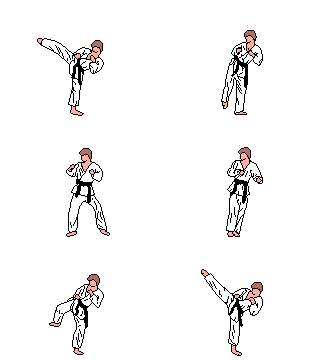
6th Gup Syllabus
Bending ready stance A / Fixed stance / Close stance / Close ready stance A / Inner forearm circular block
Crescent kick / Fixed stance side Punch / Knifehand inward strike / Reverse knifehand strike / Vertical kick
Pick shape kick / Twisting kick / Reverse hooking kick / Won-Hyo / One step sparring / Destruction / Self Defence / Theory
STANCES
| Bending ready stance A (guburyo junbi sogi A)
When standing with a left foot executing a right forearm guarding block, it is called a left bending ready stance and vice-versa. It is principally used for a preparotory position of side peircing and side thrusting kicks.
|
|
|
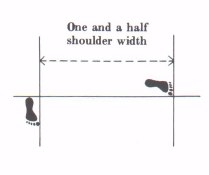
| Fixed stance (gojung sogi)
It is an effective stance for attack and defense to the side. This stance is similar to the L-stance with the following exceptions:
1. The body weight is distributed evenly on both legs. (50 - 50)
2. The distance between the big toes is about one and a half shoulder width.
When the right foot is advanced, the stance is called a right fixed stance and vice-versa. It is always half facing, both in attack and defense.
|
 |
 |
Close stance (moa sogi)
Stand with the feet together. It can be either full facing or side facing
|
|
Close ready stance A (moa junbi sogi A)
The distance betwwen the philtrum and the fists is about 30 centimetres.
|
|
DEFENSIVE TECHNIQUES
| Inner forearm circular block (an palmok dollimyo magki)
This technique is to block a combination of hand and foot attack. A walking stance is most suitable for this block.
1. The fist should reach the same level as the defender's shoulder. This shoulder should be slightly lower than the opposite one at the moment of the block.
2. The blocking tool should reach the attacking foot in a large circular motion to enable the blocking hand to scoop the foot.
3. Keep the body half facing the target at the moment of the block.
|
|
|
|
|
| Crescent kick (bandal chagi)
This kick is used for blocking the attacking hand or foot to the middle section and area below. The sole of the foot is the tool which should reach the target in an arc.
An advantage of this technique is that the blocking foot can be available for a swift counter attack.
The main target should be the elbow joint, achilles tendon or ankle joint with the forearm and outer or inner tibia secondary. Though the outside block is more effective, an inside block is also used frequently.
Keep the back heel faced downward at the moment of the block.
This technique is classified into low and middle cresent kicks
|
|
OFFENSIVE TECHNIQUES
| Fixed stance side Punch (gojung so yop jirugi)
when the punch is delivered to the flank it is called a side punch.
This technique can be found in the pattern Won-Hyo. Movements 3 & 6.
|
|
| Knifehand inward strike (sonkal anuro taerigi)
The attacking tool reaches the chest line at the moment of impact. In this case being the knifehand. This techniqe is effective in attacking the target located at the side front.
|
|
|
|
Reverse knifehand strike (sonkal dung taerigi)
This is mainly performed with walking, sitting and X-stances but occasionally a parallel or close stance is used. Bring the opposite hand under the elbow joint at the moment of impact and be sure to attack the target from the side front so that the reverse knifehand stays at the center of the attackers own body.
|
| Vertical kick (sewo chagi)
This technique is employed in attacking the target from a 90 degree angle. It is performed mainly with the footsword and occasionally with the reverse footsword. The foot must be vertical to the target while bending the leg about 30 degrees at the moment of impact. The attacking tool reaches the target in an arc.
|
inward (anuro)
|
outward (bakuro)
|
| Pick shape kick (gokaeng-i chagi)
This a variation of a downward kick. The attacking tool reaches the target in a vertical line, and besides its attacking role is frequently used in harassing and keeping away the opponent. The back heel and ball of the foot are used as the attacking tools. Be sure to keep the the leg straight while it is rising. The heel of the stationary foot is normally off the ground while raising.
Back Heel The skull and clavicle are the primary targets, with the chest and face secondry. the point of focus should not be lower than the attackers own shoulder and the leg should be bent about 45 degrees at the moment of impact.
Ball of the foot The face is the primary target with the jaw and the temple secondry. Keep the leg slightly bent at the moment of impact.
|
|
| Twisting kick (bituro chagi)
If the attacking tool approaches the target area describing an outcurved line the kick can be defined as a twisting kick. The kick is divided into low, middle and high twisting kicks. The foot should be vertical to the target at the moment of impact except for the case of a high twisting kick.
|
Low Twisting Kick
It is used in attacking the opponent in front. The inner thigh presents the best target for this kick, and the ball of the foot is the supreme weapon, though occasionally the knee and toes are used.
|
|
|
|
|
Middle twisting kick
This kick is used for attacking the opponent at the side front. The philtrum, solar plexus and scrotom are the main targets while the ball of the foot and instep are chiefly used, though occasionally the knee or toes are used.
|
|
High twisting kick
This technique is employed in attacking the opponent at the side rear. The face is the only target , and the ball of the foot is chiefly used, though occasionally the toes can be used when wearing shoes. Keep the back heel facing front at the moment of impact..
|
|
| Reverse hooking kick (bandae dollyo gorochagi)
This is a variation of a reverse turning kick, and the other to hook the opponent who moves in during the execution of the kick.
1. bring the heel close to the body soon after the kick.
2. Bend the kicking leg properly during the kick.
|
|
|
PATTERNS
| Won-Hyo Tul 28 movements
 |
Won-Hyo was the noted monk who introduced Buddhism to the Silla Dynasty in the year 686 A.D.
|
 |
Ready posture: Close Ready stance A
1. Move the left foot to B, forming a right L- stance toward B while executing a twin forearm block.
2. Execute a high inward strike to B with the right knifehand while bringing the the left fist in front of the right shoulder, while maintaining a right L - stance toward B.
3. Execute a middle punch to B with the left fist while forming a left fixed stance toward B, slipping the left foot to B.
4. Bring the left foot to the right foot, and then move the right foot to A, forming a left L- stance toward A while executing a twin forearm block.
5.Execute a high inward strike to A with the left knifehand while bringing the right side fist in front of the left shoulder, maintaining a left L - stance toward A.
6. Execute a middle punch to A with the right fist while forming a right fixed stance toward A, slipping the right foot to A.
7. Bring the right foot to the left foot, and then turn the face toward D while forming a right bending ready stance A toward D.
8. Execute a middle side peircing kick to D with the left foot.
9. Lower the left foot to D, forming a right L - stance toward D while executing a middle guarding block to D with a knifehand.
10. Move the right foot to D, forming a left L - stance toward D while executing a middle guarding block to D with a knifehand.
11. Move the left foot to D, forming a right L - stance toward D while executing a middle guarding block to D with a knifehand.
12. Move the right foot to D, forming a right walking stance toward D while executing a middle thrust to D with the right straight fingertip.
13. Move the left foot to E, turning counter-clockwise to form a right L - stance toward E, at the same time executing a twin forearm block.
14. Execute a high inward strike to E with the right knifehand, bringing the left side fist in front of the right shoulder while maintaining a right L - stance toward E.
15. Execute a middle punch to E with the left fist while forming a left fixed stance toward E, slipping the left foot to E.
16. Bring the left foot to the right foot, and then move the right foot to F, forming a L - stance toward F while executing a twin forearm block.
17. Execute a high inward strike to F with the left knifehand, bringing the right side fist in front of thr left shoulder while maintaining a left L - stance toward F.
18. Execute a middle punch to F with the right fist while forming a right fixed stance toward F, slipping the right foot.
19. Bring the right foot to the left foot, and then move the left foot to C, forming a left walking stance toward C while executing a circular block to CF with the right inner forearm.
20. Execute a low front snap kick to C with the right foot keeping the position of the hands as they were
in 19.
21. Lower the right foot to C, forming a right walking stance toward C while executing a middle punch to C with the left fist.
22. Execute a circular block to CE with the left inner forearm while maintaining a right walking stance toward C.
23. Execute a low front snap kick to C with the left foot, keeping the position of the hands as they were
in 22.
24. Lower the left foot to C, forming a left walking stance toward C while executing a middle punch to C with the right fist.
25. Turn the face toward C, forming a left bending ready stance A toward C.
26. Execute a middle side peircing kick to C with the right foot.
27. Lower the right foot on line CD, and then move the left foot to B, turning counter-clockwise to form a right L - stance toward B, at the same time executing a middle guarding block to B with the forearm.
28. Bring the left foot to the right foot, and then move the right foot to A, forming a left L- stance toward A while executing a middle forearm guarding block to A with the forearm.
End: Bring the right foot back to ready posture.
|
SPARRING
One step sparring (ilbo matsogi) foot or hand techniquesCompulsory techniques:
Vertical kick, downward kick, twisting kick, reverse hooking kick
1. Attack - punch / counter attack - vertical kick
2. Attack - punch / counter attack - downward kicK
3. Attack - punch / counter attack - twisting kick
4. Attack - punch / counter attack - reverse hooking kick
5 to 10. Attack - own choice / counter attack - own choice
Free sparring (jayu matsogi) Grading & Tournament
SELF DEFENCE showing: attacking, breaking and releasing
Release from bear hug from behind - over arms
Release from bear hug from behind - under arms
DESTRUCTIONTurning kick (dollyo chagi)
THEORYAll Taekwon-Do Terminology above
Meaning of the Green Belt
Green signifies the plants growth as the taekwon-Do skill begins to develop.
Rules of conduct: Dress for training.
1. On arrival, check your dobok and remove all accessories eg. rings, necklaces, watches, earrings and anything else dangerous.
2. Do dok must always be clean, ironed and worn correctly. It must be in good repair. Students may wear a white singlet or T shirt under their do bok top with the permission of their instructor.
3. Belts shall be worn by those qualified to wear them, wrapped around the waist once and tied in the correct manner. Care should be taken to ensure the colour of the belt is representative of the grade. Some dyed belts often do not give a true colour.
4. The correct uniform to be worn is white do bok top with white do bok trousers. balk belt holders shall wear an official ITFNZ black belt and have 2.5 cm wide black trimming around the bottom of the jacket. 4th dans and distinquished by 3cm black stripes down the outside of the jacket sleves and trousers.
5. The do bok top should have the ITF badge correctly mounted on the front left breast, and the ITFNZ badge on the right. A small club badge may be attached to the right sleve for idividual club identity. (This should be smaller than the ITFNZ badge.) For international events a small national flag of the member's country may be attached to the left sleeve, midway between the shoulder and elbow. Qualified instructors & international instructors shall wear the approved ITFNZ instructors' insignia.
6. If the do bok needs to be tidied up, students must turn to the left to adjust.
7. Do bok should not be worn outside the do jang unless on special occasions as specified by the instructor.
8. Members who have participated in an authorised event of the foundation shall be allowed to wear any specialised
do bok worn for that event.
Credits
Minimum of 4 since starting TKD