


7th Gup Syllabus
Outer forearm high wedging block / Palm downward block / Middle reverse punch / Back fist high side strike
Straight fingertip thrust / Back piercing kick / Downward kick / Reverse turning kick / Do-San /Three step sparring
DEFENSIVE TECHNIQUES
|
Outer forearm high wedging block (pakat palmok nopunde hechyo makgi)
This technique is used to block a twin fist vertical punch, twin fore knuckle fist punch or twin knifehand inward strike while preventing the neck, head or lapel from being grabbed. It can be performed with both the outer and inner forearm, knifehand and reverse knifehand. The distance between the blocking tools is equal to one shoulder width of the defender. Keep the elbows bent about 35 degrees outward at the moment of the block.
|
|
| Palm downward block (sonbadak naeryo makgi)
The purpose of this technique is to drop the opponent's hand, foot or weapon attacking the solar plexus and point below. It is executed principally from rear foot and L stances, though occasionally a walking or vertical stance is used. The blocking tool should reach its point of focus in a circular motion, keeping the elbow bent about 45 degrees at the moment of the block.
|
|
OFFENSIVE TECHNIQUES
|
Middle reverse punch (kaunde bandae jirugi)
If the fist is delivered from the opposite side of the leg which is fully bent it is called a reverse punch.
|
|
| Back fist high side strike (dung joomuk nopunde yop taerigi)
This technique is normally used for attacking the temple. Keep the back fist half facing the target with the arm slightly bent at the moment of impact. The main knuckles of the forefinger and middle finger are the parts used. This technique can also be used for attacking the skull, forehead, philtrum and abdomen. Secondary targets are the floating ribs and epigastrium.
|
|
|
Straight fingertip thrust (sun sonkut tulgi)
The palm faces inward at the moment of impact. It is used for thrusting to either the solar plexus or the abdomen.
|
|
|
Back piercing kick (dwitcha jirugi)
This kick is quite effective for attacking an opponent approaching from the rear. The foot sword is used as an attacking tool. The advantage of this technique is the ability to reach a long distance even without changing the direction of the body. Keep the toes of the stationary foot pointed to the front with the ankle of the kicking foot bent at a 45-degree angle at the moment of impact.
|
| Downward kick (naeryo chagi)
This kick is useful for attacking an opponent by passing over an obstacle such as another person. The back heel reaches the target in a downward line from the apex of the kick. The point of focus should not be lower than the attackers own solar plexus because this may cause loss of power. The skull is the main target, with the clavicle the secondary target
|
|
|
.
|
Reverse turning kick (bandae dollyo chagi)
This is a reverse form of a turning kick used against an opponent at the side rear. It is mainly performed with the back heel but occasionally the ball of the foot is used. This technique can be performed with either front or rear foot as far as the stationary foot is concerned, because the effectiveness of this kick depends on maximum speed while turning. Special care should be taken to maintain balance and posture. It is broken into low, middle and high reverse turning kicks.
|
PATTERN
| Do-San Tul 24 movements
 |
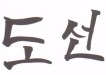
Do-san is the pseudonym of the patriot Ahn Chang Ho (1876 - 1938). The 24 movements represent his entire life, which he devoted to furthering education in Korea and the Korean independence movement.
|
 |
Ready Posture: Parallel ready stance
1. Move the left foot to B, forming a left walking stance toward B while executing a high side block to B with the left outer forearm.
2. Execute a middle punch to B with the right fist while maintaining a left walking stance toward B.
3. Move the left foot on the AB line, and then turn clockwise to form a right walking stance toward A while
executing a high side block to A with the right outer forearm.
4. Execute a middle punch to A with the left fist while maintaining a right walking stance toward A.
5. Move the left foot to D, forming a right L stance toward D while executing a middle-guarding block to D with a
knifehand.
6. Move the right foot to D, forming a right walking stance toward D while executing a middle thrust to D with
the right straight fingertip.
7. Twist the right knifehand together with the body counter clockwise until the palm faces downward and then
move the left foot to D, turning counter clockwise to form a left walking stance toward D while executing a high
side strike to D with the left back fist.
8. Move the right foot to D, forming a right walking stance toward D while executing a high side strike to D with
the right back fist.
9. Move the left foot to E, turning counter clockwise to form a left walking stance toward E while executing a
high side block to E with the left outer forearm.
10. Execute a middle punch to E with the right fist while maintaining a left walking stance toward E.
11. Move the left foot on line EF, and then turn clockwise to form a right walking stance toward F while
executing a high side block to F with the right outer forearm.
12. Execute a middle punch to F, with the left fist while maintaining a right walking stance toward F.
13. Move the foot to CE, forming a left walking stance toward CE, at the same time executing a high wedging
block to CE with the outer forearm.
14. Execute a middle front snap kick to CE with the right foot, keeping the position of the hands as they
were in 13.
15. Lower the right foot to CE, forming a right walking stance toward CE while executing a middle punch to CE
with the right fist.
16. Execute a middle punch to CE with the left fist while maintaining a right walking stance toward CE.
Perform 15 & 16 in fast motion.
17. Move the right foot to CF, forming a right walking stance toward CF while executing a high wedging block to
CF with the outer forearm.
18. Execute a middle front snap kick to CF with the left foot, keeping the position of the hands as they
were in 17.
19. Lower the foot to CF, forming a left walking stance toward CF while executing a middle punch to CF with the
left fist.
20. Execute a middle punch to CF with the right fist while maintaining a left walking stance toward CF.
Perform 19 & 20 in fast motion.
21. Move the left foot to C, forming a left walking stance toward C, at the same time executing a rising block
with the left forearm.
22. Move the right foot to C, forming a right walking stance toward C while executing a rising block with the
right forearm.
23. Move the left foot to B, turning counter clockwise to form a sitting stance toward D while executing a middle
side strike to B with the left knifehand.
24. Bring the left foot to the right foot, and then move the right foot to A, forming a sitting stance toward D while
executing a middle side strike to A with the right knifehand.
End: Bring the right foot back to the ready posture.
|
SPARRING
Three step sparring (sambo matsogi)
With partner one way foot techniques.
Compulsory techniques:
Front snap kick, turning kick, side piercing kick, spinning back piercing kick,
downward kick, reverse turning kick
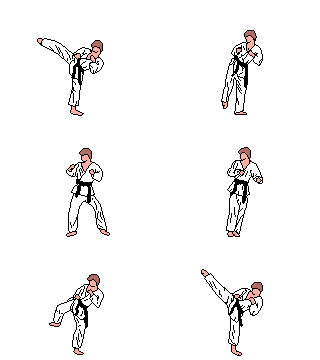
1. L-stance forearm guarding blocks / front leg side front snap kick
2. L-stance outer forearm inward blocks / front leg side piercing kick
3. L-stance outer Knifehand inward block / front leg turning kick
4. Own choice of block / spinning back piercing kick
5. Own choice of block / downward kick
6. Own choice of block / reverse tuning kick
Free sparring (jayu matsogi)
SELF DEFENCE showing: attacking, breaking and releasing
Release per Do-San, movement 7
Release from lapel grab with one hand
Release from lapel grab with two hands
DESTRUCTIONSide piercing kick (yopcha jirugi)
THEORY All terminology above
Rules of conduct: Inside the do-jang
1. All members should treat each other with courtesy.
2. Members shall address one another courteously, and use titles, e.g. Yes sir, No Maám, Mr Bloggs, Mrs Kim, Dr
Who, etc.
3. The instructor should be addressed as Sir/Maám or by his/her surname, preceded by his/her title Mr/Mrs/Dr.
4. Questions or answers should end with the appropriate "Sir" or "Maám".
5. All instructions issued by the instructor or senior members within the do jang must be obeyed.
6. When seeking to meet the instructor or senior, a student should stand at attention and keep alert to the situation at
hand until approached or spoken to by the instructor or senior. The student shall ensure the do bok is well adjusted
prior to the meeting.
7. Members must not make any unnecessary noise or disturbance inside the do jang.
8. Members should ensure visitors are treated with courtesy, provided with seating, accompanied and given advice
where necessary.
9. Members must ensure their do jang is kept tidy.
10. Members should not smoke in the do jang. Eating or drinking only at the instructor's discretion.
11. Members must not leave the do jang without permission of the instructor.
12. Members must not raise any objection or arguments during training in the do jang.
13. Visiting instructors or seniors should be acknowledged by all members present upon entering the do jang.
14. Assistant instructors or other senior members (as indicated by the instructor), should advise, in advance,
their anticipated non- attendance at a training session. This does not only a courtesy but also has practical
implications.
15. The junior students present shall be responsible for the setting up and tidying up of equipment each training
session.
16. The senior members (other than the instructor or his/her assistant) shall supervise the putting away of equipment
by junior
17. members after the completion of training, having regards to the wishes of the instructor.
18. Students training at another branch should seek permission of their own instructor, and that of the instructor of
the branch being visited, prior to commencing the session.
19.Visiting members should be formally introduced to the club at the commencement of training.
20. All training fees or payments must be paid promptly at times indicated by the instructor.
|
Credits
Minimum of 3 since starting TKD
|
|
|
|
|
|
|
|
|