8th Gup Syllabus
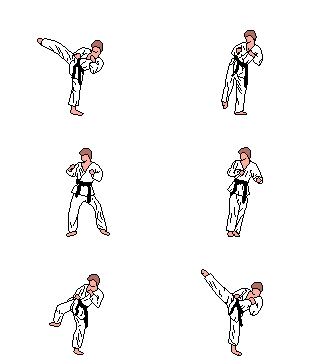
Flat fingertip thrust / Turning kick / Side turning kick / Side piercing kick / Dan-Gun / Three step sparring
DEFENSIVE TECHNIQUES
| Forearm rising block (palmok chookyo makgi)
The main purpose of this technique is to block the opponent's hand, foot or weapon directed towards the head, although it is frequently used against a punch or side piercing kick directed against the bridge of the nose and area above. Always maintain a full facing posture towards the opponent at the moment of block, when utilising a walking, sitting, parallel, close, one-leg, diagonal or x-stance.
Basic Principles:
1. The blocking tool must stay at the centre of the defenders forehead or face at the moment of block.
2. The fist should be slightly higher than the elbow.
3. The distance between the inner forearm and forehead is about seven centimetres with the elbow bent at a 45-degree angle.
4. The inner forearm reaches the same level as the forehead.
|
| Outer forearm side block (pakat palmok yop magki)
The outer one-third of the arm, from the wrist to the elbow, is used as the blocking tool. This technique can be performed in most stances with the body half-facing.
|
|
|
Knifehand side block (sonkal yop makgi)
This technique can be performed in most stances with the body half-facing, and the knifehand being the blocking tool.
|
|
|
Twin forearm block (sang palmok magki)
This technique can be used to block a simultaneous attack from the front and side. The side block, however is the primary defence. This block can be performed with nearly all stances but walking stance. An L-stance or rear foot stance is chiefly used. The side-blocking forearm usually performs a middle block. It should be stressed that although a rising block may also be effective against an attack toward the forehead, the side block is the primary one. When blocking from a left L-stance, bring the right forearm inside of the left forearm and vice versa.
|
| Forearm inward block (palmok anuro magki)
In this technique the blocking tool reaches the target from an outward to inward trajectory to the chest line. This block can be executed in all stances and is used for blocking the attacking foot or hand directed towards the chest line.
|
|
|
Forearm guarding block (palmok daebi makgi)
This block is frequently used as a ready posture in free sparring, since one can position oneself in a half facing posture and protect the body completely with both hands. Although the L stance or rear foot stances are most widely used, it can also be used with all other stances.
Rules for a guarding block:
1 Keep the blocking tool half facing the target at the moment of blocking.
2 Bring the opposite knifehand or side fist in front of the chest 3 centimetres from the body. The guarding hands should be flexible enough to protect the whole body against an attack.
3 keep the body half facing the target at all times.
|
| Knifehand guarding block (sonkal daebi makgi)
Same as a forearm guarding block with the difference being the knifehand being the blocking tool and the opposite knifehand is brought in front of the chest 3 centimetres from the body.
|
|
OFFENSIVE TECHNIQUES
| Knifehand side strike (sonkal yop taerigi)
The attacking tool reaches the target from inward to outward and forms a straight line with the centre of the shoulders at the moment of impact. It is mainly executed from a sitting, close,
L-stance, and X-stance.
|
|
| Flat fingertip thrust (opun sonkut tulgi)
The palm is faced downward at the moment of impact. It is chiefly
used for attacking the ribs, eyes and occasionally the abdomen.
This technique is usually executed from a walking, low,
sitting or L-stance, though occasionally from a parallel, close,
rear foot or X-stance.
|
|
| Turning kick (dollyo chagi)
The turning kick is ideal for attacking an opponent positioned at the side front, and is usually performed with the ball of the foot, instep and knee, however, the toes can be used if wearing shoes. This kick is normally executed from the rear, though occasionally the front foot. This technique is classified into low, middle and high turning kicks.
The main principles of the kick are:
The hip must be swung forward to enable the foot to reach the target
in an arc.
The ball of the foot must be vertical to the target at the moment of impact.
The foot must have reached the apex of the kick shortly before contact so
the toes are pointed slightly downward at the instant of contact.
The toes of the stationary foot should point 45 degrees outward at the
moment of impact.
The kicking leg must not be bent more than absolutely necessary at the
moment of impact.
The arms must be kept within sight while kicking.
|
| Side turning kick (yop dollyo chagi)
This is a variation of a turning kick. One of the advantages is the ability to attack the opponent standing abreast or in front. The ball of the foot and instep are the attacking tools. The toes of the stationary foot should point about 75 degrees outward while the kicking leg is kept straight at the moment of impact. It is also divided into low, middle and high side turning kicks.
|
|
| Side piercing kick (yopcha jirugi)
This is one of the most effective techniques for attacking an opponent at the flank. The footsword is the attacking tool. The vital spots are the temple, armpit, floating ribs, neck artery, philtrum, point of the chin, and solar plexus.
The main principles of this kick are:
The attacking tool must reach the target in a straight line with a
revolving motion.
Regardless of the stance, the footsword must be brought to the inner
knee joint of the stationary leg prior to delivering the kick.
Keep the toes of the kicking foot faced slightly downwards and the toes
of the stationary foot pointed about 75 degrees outwards at the moment
of impact.
For the maximum height, lean the body away from the kick as far as
possible while still maintaining balance.
Unless advised otherwise by an instructor, execute a high punch using
a right fist with a right foot and vice versa.
The stationary foot pivots allowing the hip to rotate with the kick.
|
Pattern
| Dan-Gun Tul 21 movements
 |
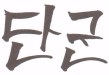
Dan Gun is named after the holy Dan Gun, the legendary founder of Korea in the year 2333 BC
|
 |
Ready Posture: Parallel ready stance
1. Move the left foot to B, forming a right L-stance toward B, at the same time executing a middle guarding
block to B with a knifehand.
2. Move the right foot to B, forming a right walking stance toward B while executing a high punch to B with
the right fist.
3. Move the right foot to A, turning clockwise to form a left L-stance toward A, at the same time executing a
middle guarding block to A with a knifehand.
4. Move the left foot to A, forming a left walking stance toward A while executing a high punch to A with the
left fist.
5. Move the left foot to D, forming a left walking stance toward d while executing a low block to D with the
left forearm.
6. Move the right foot to D, forming a right walking stance toward D while executing a high punch to D with
the right fist.
7. Move the left foot to D, forming a left walking stance toward D, at the same time executing a high punch
to D with the left fist.
8. Move the right foot to D, forming a right walking stance toward D while executing a high punch to with the
right fist.
9. Move the left foot to E, turning counter clockwise to form a right L-stance toward E while executing a twin
forearm block to E.
10. Move the right foot to E, forming a right walking stance toward E while executing a high punch to E with
the right fist.
11. Move the right foot to F, turning clockwise to form a left L-stance toward F while executing a twin
forearm block to F.
12. Move the left foot to F, forming a left walking stance toward F, at the same time executing a high punch
to F with the left fist.
13. Move the left foot to C, forming a left walking stance toward C while executing a low block to C with the
left forearm.
14. Execute a rising block with the left forearm, maintaining the left walking stance toward C. Perform 13
and 14 in a continuous motion.
15. Move the right foot to C, forming a right walking stance toward C, at the same time executing a rising
block with the right forearm.
16. Move the left foot to C, forming a left walking stance toward C while executing a rising block with the left
forearm.
17. Move the right foot to C, forming a right walking stance toward C, at the same time executing a rising
block with the right forearm.
18. Move the left foot to B, turning counter clockwise to form a right L-stance toward B while executing a
middle outward strike to B with the left knife-hand.
19. Move the right foot to B, forming a right walking stance toward B while executing a high punch to B with
the right fist.
20. Move the right foot to A, turning clockwise to form a left L-stance toward A while executing a middle
outward strike to A with the right knifehand.
21. Move the left foot to A, forming a left walking stance toward A, at the same time executing a high punch
to A with the left fist.
End: Bring the left foot back to ready posture.
|
SPARRING
Three step sparring (sambo matsogi)
With partner, one way, hand techniques
Compulsory techniques: Front punch, Knifehand side strike, flat fingertip thrust
1. Walking stance inner forearm side blocks / flat fingertip thrust
2. Walking stance knifehand side blocks/ knifehand side strike
3. Walking stance outer forearm side block / front punch
4. Own choice
5. Own choice
6. Own choice
SELF DEFENCEshowing: attacking, breaking and releasing
1. Release from two-hand grab to one wrist.
2. Release from two hand grab to both wrists
DESTRUCTION Side front snap kick (yobap cha busigi)
THEORYAll terminology above
Counting
1 - hana 2 - dool 3 - set 4 - net 5 - dasot 6 - yosot 7 - ilgop 8 - yodul 9 - ahop 10 - yol
Meaning of the Yellow belt
Yellow signifies the earth from which a plant sprouts and takes root as the Taekwon-Do foundation is being laid.
Rules of conduct
Preparation for training
1. Members must make sure they are clean and all nails are cut short for safety reasons.
2. Members should arrive at least 10 minutes before the commencement of class and be prepared both physically and mentally.
Entering the do-jang
1. Remove footwear prior to entering the designated training area.
2. Where several people are entering, ensure the senior person or adult is shown the courtesy of entering first.
3. Bow when entering or leaving the do jang
4. Ensure shoes or other articles are neatly stored in accordance with the wishes of the instructor.
5. Bow and acknowledge others present in the do jang which should inclide firstly the instructor, the assistant instructor, then senior members. Children must acknowledge adults. Similar courtesies should be paid when visiting other martial arts do jang.
Credit Points 2 required