9th Gup Syllabus
Sitting stance / Sitting ready stance / L - Stance / Single stepping / Spot and step turning / Side rising kick
STANCES
| Sitting stance (annun sogi)
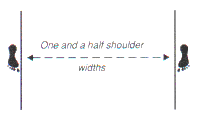
This is a very stable stance for lateral movement. It is also widely used for punching exercise and development of the legs. One of the advantages of this stance is to shift into walking stance without relocating the foot. Spread one leg to the side at a distance of approximately one and half a shoulder width between the big toes. Point the toes to the front and distribute the body weight evenly on both legs. Extend the knees outward, bending until the kneecaps come over the ball of the foot. Infuse the strength into the inner thighs and tense inward by scraping theground or floor with the side soles. Push both the chest and abdomen out and pull the hip back tensing the abdomen.
|
 |
| Sitting ready stance (annun junbi sogi)
The distance between the fists and
thigh is about 30 centimetres.
The elbows should be bent 30 degrees.
|
|
| L - Stance (niunja sogi)
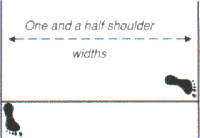
This stance is widely used for defence, though used in attack as well. The front foot is readily available for kicking with a slight shift of the body weight and with the advantage of half facing as well as body shifting. Move one foot to either front or rear to a distance of approximately one and a half times the shoulder width from the footsword of the rear foot to the toes of the front foot, forming almost a right angle. It is recommended that the toes of both feet point about 15 degrees inward, placing the front heel beyond the heel of the rear foot about 2.5 centimetres to gain better stability.
Bend the rear leg until the kneecap forms a vertical line with the toes, bending the front leg proportionally. Keep the hip aligned with the inner knee joint.The ratio of the body weight is about 70 percent on the rear leg and 30 percent on the front leg.
|
 |
Single stepping - forward (nagagi) and backward (duruogi) Spot and step turning in various stances.DEFENSIVE TECHNIQUES
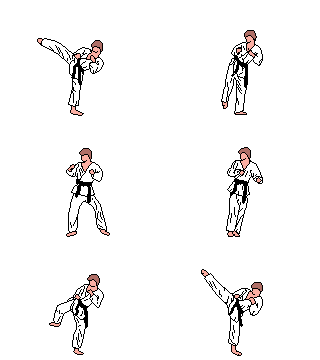
| Side rising kick (yopcha olligi)
This technique is used to spring up the attacking hand or foot directed to the middle section or above. The footsword is the blocking tool and it should reach the target in an arc.
|
|
A side rising kick can also be used as a dynamic stretching exercise.
|
|
OFFENSIVE TECHNIQUES
| Side front snap kick (yobap cha busigi)
This technique is used in attacking an opponent located at the side front and is chiefly executed from rear foot, vertical and L-stances. Both the principle and method of kicking are the same as those of a front snap kick with the exception that the body is half facing the opponent at the moment of impact.
|
|
PATTERN
| Chon-Ji Tul 19 Movements
 |
Means literally "the heaven the earth". It is in the orient, interpreted as the creation of the world or the beginning of human history therefore it is the initial pattern played by the beginner. This pattern consists of two similar parts, one to represent the heaven and the other the earth.
|
 |
Ready Posture: Parallel ready stance
1. Move the left foot to B, forming a left walking stance toward B while executing a low block to B with the
left forearm.
2. Move the right foot to B, forming a right walking stance toward B while executing a middle punch to B with
the right fist.
3. Move the right foot to A, turning clockwise to form a right walking stance toward A while executing a low
block to A with the right forearm.
4. Move the left foot to A, forming a left walking stance toward A while executing a middle punch to A with
the left fist.
5. Move the left foot to D, forming a left walking stance toward D while executing a low block to D with the
left forearm.
6. Move the right foot to D, forming a right walking stance toward D while executing a middle punch to D with
the right fist.
7. Move the right foot to C, turning clockwise to form a right walking stance toward C while executing a low
block to C with the right forearm.
8. Move the left foot to C, forming a left walking stance toward C while executing a middle punch to C with
the left fist.
9. Move the left foot to A, forming a right L-stance toward A while executing middle block to A with the left
inner forearm.
10. Move the right foot to A, forming a right walking stance toward A while executing a middle punch to A
with the right fist.
11. Move the right foot to B, turning clockwise to form a left L-stance toward B while executing a middle block
to B
12. Move the left foot to B, forming a left walking stance toward B while executing a middle punch to B with
the left fist.
13. Move the left foot to C, forming a right L-stance toward C while executing a middle block to C with the left
inner forearm.
14. Move the right foot to C, forming a right walking stance toward C while executing a middle punch to C
with the right fist.
15. Move the right foot to D, turning clockwise to form a left L-stance toward D while executing a middle
block to D with the right inner forearm.
16. Move the left foot to D, forming a left walking stance toward D while executing a middle punch to D with
the left fist.
17. Move the right foot to D, forming a right walking stance toward D while executing a middle
punch to D with the right fist.
18. Move the right foot to C, forming a left walking stance toward D while executing a middle punch to D with
the left fist
19. Move the left foot to C, forming a right walking stance toward D while executing a middle punch to D with
the right fist.
End. Bring the left foot back to the ready posture.
|
SPARRING
Three step sparring (sambo matsogi)
Alone, (with imaginary partner) Hand Techniques
Compulsory techniques: Inner forearm side block, front punch.
1. Walking stance inner forearm blocks / front punch
2. Walking stance outer forearm blocks / flat fingertip thrust
3. L - Stance forearm blocks / open fist punch
4. Own choice
5. Own choice
6. Own choice
SELF DEFENCEshowing: attacking, breaking and releasing
Release from grab to the wrist - opposite side
THEORYAll Taekwon-Do terminology above
Training area - do jang Training uniform - do bok Tae / kwon / Do - foot / fist / art or way
Thank you - ko mup sum neda Right - orun Left - wen
Meaning of the white belt
White signifies innocence, as that of a beginning student who has no previous knowledge of Taekwon-Do.
Theory of PowerReaction force
This is using your opponent's force to your advantage, e.g. Striking the opponent with correct timing as he is moving in, turns his own reaction force onto himself making your blow more effective.
Concentration
To apply the impact force with the smallest possible surface area by using correct attacking tool and attacking the correct vital spot.
Equilibrium
This means having correct balance at all times to enable you to generate maximum power.
Breath Control
Sharp exhaling at the moment of impact. Controlling breathing not only affect's one's stamina and speed but can also condition the body to receive a blow and will increase one's own power as well.
Mass
By twisting the hips and dropping the body weight you can maximise the amount of mass utilised thus increasing power.
Speed
This is perhaps the most important factor. It refers to the acceleration of the attacking tool towards the target. If you double your speed you will quadruple your power.
The Training Secret of Taekwon-Do1. Study the theory of power thoroughly.
2. Understand the purpose and method of each movement clearly.
3. Bring the movement of eyes, hands, feet and breath into a single co-ordinated action.
4. Choose the appropriate attacking tool for each vital spot.
5. Become familiar with the correct angle and distance for attack and defence.
6. Keep both the arms and legs bent slightly while the movement is in motion.
7. All movements must begin with a backward motion with very few exceptions. However, once the
movement is in motion it should not be stopped before reaching the target
8. Create a sine wave during the movement by utilizing the knee spring properly.
9. Exhale briefly at the movement of each blow except during a continuous movement.
Credit Points: 1 required