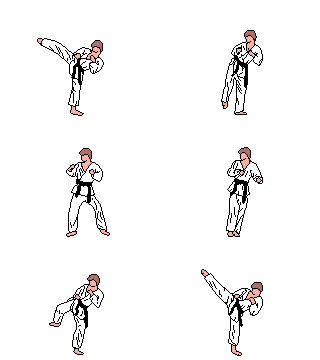
10th Gup Syllabus
Attention stance / Bow / Forearm low block / Parallel stance / Parallel ready stance / Walking stance
STANCES
| Attention stance (charyot sogi)
This is an attention position used before and after each exercise.
Feet form a 45-degree angle.
Drop the fists down naturally, bending the elbows slightly.
The fists are clenched slightly. Eyes face the front slightly above the horizontal line.
|
|
|
| Bow (kyong Ye)
Bend the body 15 degrees forward. Keep the eyes fixed on opponent's eyes.
|
|
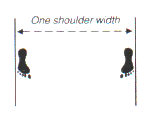
| Parallel stance (narani sogi)
Spread the feet parallel to shoulder width. Keep the toes pointing toward the front. It can be either full facing or side facing.
|
 |
| Parallel ready stance (narani junbi sogi)
This is just a parallel stance with both fists brought naturally over the abdomen. The distance between the fists is about 5 centimetres and 7 centimetres away from the abdomen. The distance between the elbows and the floating ribs is about 10 centimetres. Do not extend the elbows to the side more than necessary. Hold the upper arms forward 30 degrees while bending the forearms 40 degrees upward.
|
|
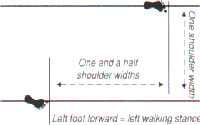
| Walking stance (gunnun sogi)
This is a strong stance for front and rear, both in attack and defence. Move one foot to either front or rear at a distance of one and a half shoulder width between the big toes and a shoulder width from one centre of the instep to the other. Bend the front leg until the kneecap forms a vertical line with the heel, extending the opposite leg fully. Distribute the body weight evenly on both feet. Keep the toes of the front foot pointing forward, the opposite foot 25 degrees outward. Tense the muscles of the feet with the feeling of pulling them toward each other. When the right leg is bent, the stance is called a right walking stance and vice-versa. It can be either full facing or half facing both in attack and defence.
|
 |
| Walking ready stance (gunnan junbi sogi)
The distance between the
fists and thigh is about
30centimetres.
The elbows should be bent
30 degrees.
|
|
DEFENSIVE TECHNIQUES
| Forearm low block (palmok najunde magki)
This is performed mainly with walking, rear foot, fixed and L-stance, though occasionally with a sitting or X-stance. Only the outer forearm is used for this technique. The tibia of the kicking foot and the back of the punching fist toward the lower abdomen are the targets. It can be performed in both obverse and reverse blocks except in an X-stance or sitting stance. Keep half facing the target at the moment of the block except with a sitting or X-stance. The distance between the under forearm and the thigh is about 20 centimetres. The forearm becomes parallel to the thigh. The elbow is bent about 25 degrees outward. Pull the other fist to the hip while blocking.
|
| Knifehand low block (sonkal najunde magki)
This block is identical to a forearm low block with the difference being the knifehand is the blocking tool opposed to the outer forearm.
|
|
|
| Inner forearm middle side block (an palmok kaunde yop magki)
The inner one-third of the arm, from the wrist to the elbow, is used as the blocking tool. This technique can be performed in most stances with the body half-facing.
|
|
| Front rising kick (apcha olligi)
This kick is used to spring up the opponents punching fist at the under forearm or the opponents foot by kicking the inner tibia. With this technique, the knee joint of the kicking leg should not be bent to severely.
|
|
|
OFFENSIVE TECHNIQUES
| Forefist front punch (ap joomuk jirugi)
The forefist is generally used for attacking the philtrum, ribs, solar plexus, chest, abdomen, jaw, etc. The main knuckles of the forefinger and middle finger are the punching parts. The top and the front of the fist should form a right angle so the punching parts can be closely contacted with the target. The wrist should not be bent when the fist is clenched.
Basic principles:
Clench the fist firmly at the moment of impact so that it acts as a hammer instead of a cotton ball.
Punch from the hip to the target at full speed using the shortest distance.
Avoid unnecessary tension of the arms and shoulders.
Pull the opposite fist simultaneously to the hip as the punching fist moves out with few exceptions.
Relax the muscle immediately after the fist has reached the target.
Keep the back straight at the moment of impact.
Do not pull the shoulder at the moment of impact.
The fist must turn a full 180 degrees at the moment of impact.
The back fist must face downward when the fist is pulled to the hip.
The rear foot in all cases must be placed firmly at the moment of impact to contain rebound.
|
|
|
|
High (nopunde)
|
Middle (kaunde)
|
Low (najunde)
|
| Front snap kick (apcha busigi)
This technique is designed to attack an opponent in the front. The face, solar plexus, abdomen, scrotum, armpit and floating ribs are the targets. It is performed with the ball of the foot, instep, toes and knee, and is broken down into low and middle front snap kicks as far as the ball of the foot and toes are concerned.
The common principles of this kick:
The stationary leg must be relaxed at the moment of impact.
The knee of the kicking leg must be brought sharply toward
the chest prior to kicking.
These two motions must be co-ordinated in one smooth, swift
action.
The attacking tool must reach the target in a straight line.
The kicking foot must be withdrawn immediately after the kick,
then brought back to the floor.
The toes of the stationary foot should point to the front at the
moment of impact.
The stationary foot must not pivot throughout the kicking.
|
FUNDEMENTAL EXERCISES
| Four direction punch (saju jirugi) |
 |
Right Four Direction Punch
Ready Posture: Parallel Ready stance
1. Move the right foot to D, forming a right walking stance toward D while executing a middle punch to D
with the right fist.
2. Move the right foot to A, forming a left walking stance toward B while executing a low block to B with the
left forearm.
3. Move the right foot to B, forming a right walking stance toward B while executing a middle punch to B
with the rightfist.
4. Move the right foot to B forming a left walking stance toward C while executing a low block to C with the
left forearm.
5. Move the right foot to C, forming a right walking stance toward C while executing a middle punch to C
with the right fist.
6. Move the left foot to B forming a left walking stance toward A while executing a low block to A with the
left forearm.
7. Move the right foot to A, forming a right walking stance toward A while executing a middle punch to A
with the right fist.
Bring the right foot back to the ready posture.
Left Four Direction Punch
1. Move the left foot to D, forming a left walking stance toward D while executing a middle punch to D with
the left fist
2. Move the left to B, forming a right walking stance toward A while executing a low block to A with the right
forearm.
3. Move the left foot to A, forming a left walking stance toward A while executing a middle punch to A with
the left fist.
4. Move the left foot to D, forming a right walking stance toward C while executing a low block to C with the
right forearm.
5. Move the left to C, forming a left walking stance toward C while executing a middle punch to C with the
left fist
6. Move the left foot to A, forming a right walking toward B while executing a low block to B with the right
forearm.
7. Move the left foot to B, forming a left walking stance toward B while executing a middle punch to B with
the left fist.
Bring the left foot back to ready posture.
|
| Four direction block (saju magki)
|
|
Right Four Direction Block
Ready Posture: Parallel ready stance
1. Move the right foot to C forming a left walking stance toward D while executing a low block to D with the
left knifehand.
2. Move the right foot to D forming a right walking stance toward D while executing a middle side block to D
with the right inner forearm.
3. Move the right foot to A, forming a left walking stance toward B while executing a low block to B with the
left knifehand
4. Move the right foot to B forming a right walking stance toward B while executing a middle side block to B
with the right inner forearm.
5. Move the right foot to D forming a left walking stance toward C while executing a low block to C with the
left knifehand.
6. Move the right foot to C forming a right walking stance toward C while executing a middle side block to C
with the right inner forearm.
7. Move the right foot to B forming a left walking stance toward A while executing a low block to A with the
left knifehand
8. Move the right foot to A forming a right walking stance toward A while executing a middle side block to A
with the right inner forearm.
Bring the right foot back to ready posture.
Left Four Direction Block
1. Move the left foot to C forming a right walking stance toward D while executing a low block to D with the
right knifehand
2. Move the left foot to D forming a left walking stance toward D while executing a middle side block to D
with the left inner forearm.
3. Move the left foot to B forming a right walking stance toward A while executing a low block to A with the
right knifehand.
4. Move the left foot to A forming a left walking stance toward A while executing a middle side block to A
with the left inner forearm.
5. Move the right foot to D forming a right walking stance toward C while executing a low block to C with
the right knifehand
6. Move the left foot to C forming a left walking stance toward C while executing a middle side block to C
with the left inner forearm.
7. Move the left foot to A forming a right walking stance toward B while executing a low block to B with the
right knifehand
8. Move the left foot to B forming a left walking stance toward B while executing a middle side block to B
with the left inner forearm.
Bring the left foot back to ready posture.
|
SELF DEFENCEShowing: attacking, breaking and releasing
Release from grab to the wrist - same side.
THEORY All Taekwon-Do terminology above
Founder of Taekwon-Do: General Choi Hong Hi - 9th Dan
Tenets of Taekwon-Do
Courtesy
Integrity
Perseverance
Self Control
Indomitable Spirit
|
 |
Student Oath
I shall observe the tenets of Taekwon-do
I shall respect the instructor and seniors
I shall never misuse Taekwon-Do
I shall be a champion of freedom and justice
I shall build a more peaceful world
|